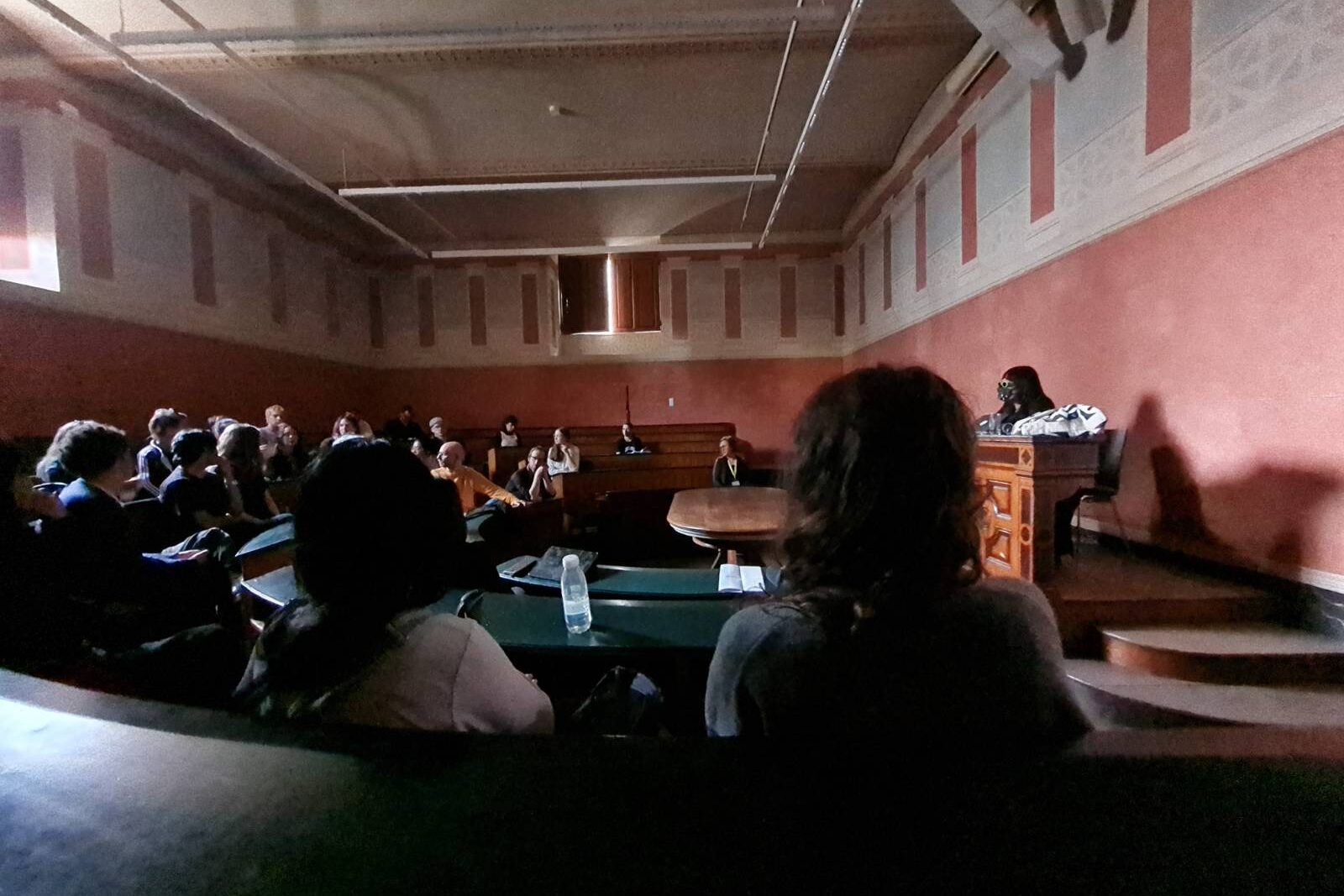
I had the pleasure to talk at this conference organised at the University of Applied Arts Vienna.
Screenshot
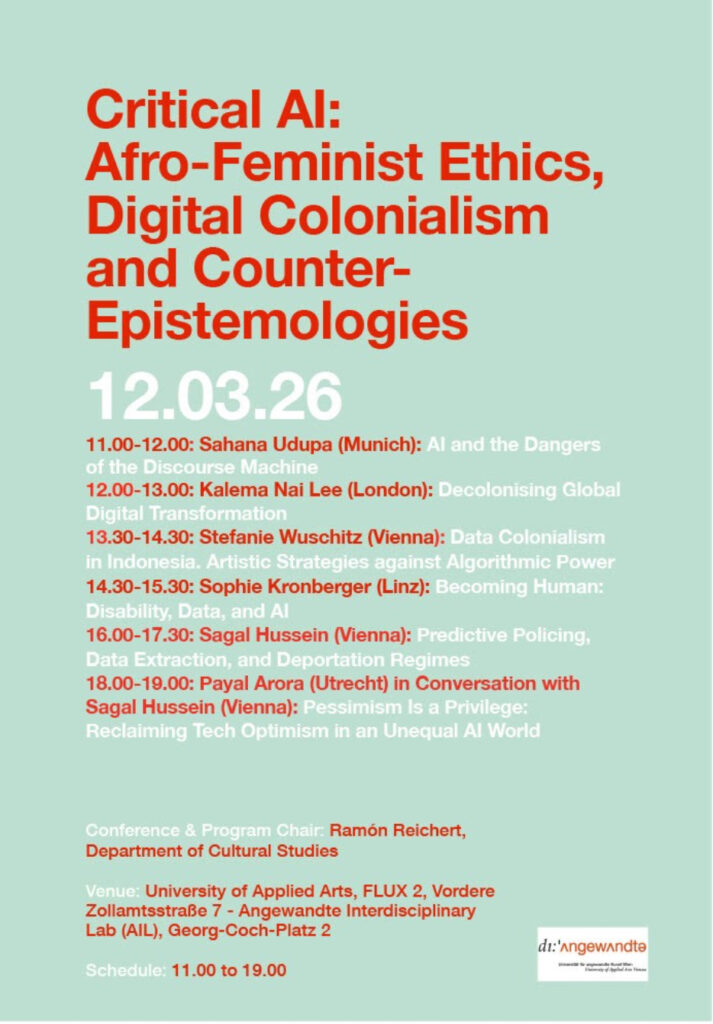
Reclaiming Agency in the Age of AI: Afro-Feminist Ethics, Digital Colonialism and Counter-Epistemologies
The conference Critical AI Studies situates Artificial Intelligence within the framework of Cultural Materialism, Critical AI Studies, Black Studies, and Afro-Feminism, approaching AI as a socio-technical formation grounded in data extraction, labour regimes, and global power asymmetries. Central to this perspective is the recognition of data labour as a foundational yet largely invisible component of AI systems, encompassing practices of data generation, annotation, moderation, maintenance, and care.
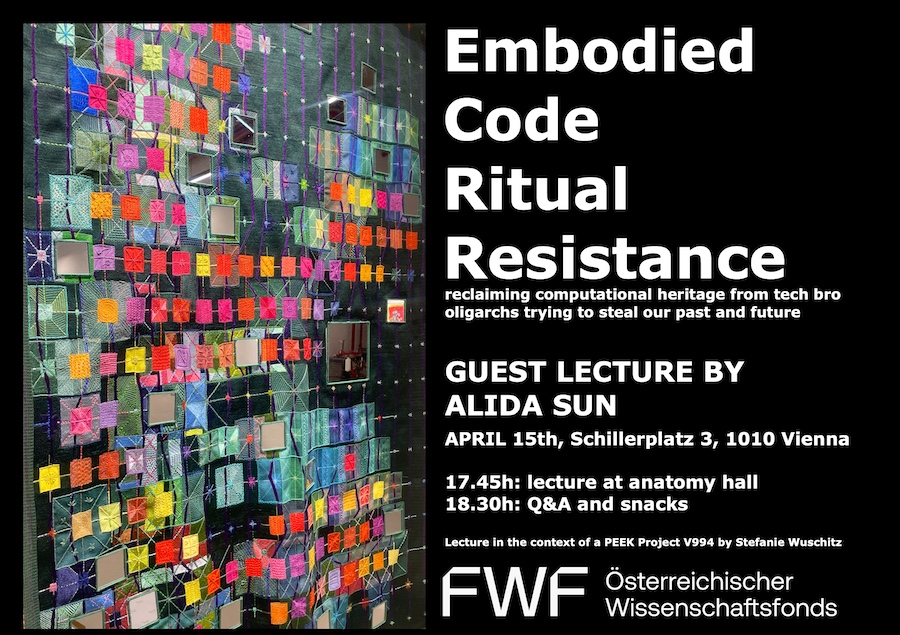
Alida Sun’s work strongly speaks to the topics in my project and questions we discuss here at the Academy of Fine Arts Vienna. So I felt extremely honored that she was with us, at the Anatomy hall. We had the chance to have a Q&A with her afer her lecture. Alida Sun is based in Berlin at the moment, but has international art exhibitions, like for example a large solo show in New Delhi. Alida Sun builds audio-visual instruments that transform her movements into visuals and sounds. With a background in coding and tech culture she enjoys coding as a physical process to create art. This way coding turns into a physical ritual. It reminds us of the times when art was tangible, hardwired into craft. When iteration was necessary for crafting and was an embodied experience. When Alida Sun thinks highly appreciated forms of self expression in patriarchal society, like tech production, with highly undervalued forms of self expression, like textile manufacturing by women weavers in India, she outlines women’s invisible and underpaid labour. I want to quote Alida Sun:
“The hierarchy of the two [art versus craft] is deeply entrenched in patriarchy and colonialism.”
Alida Sun will explore play as research methodology, data as material for somatic inquiry, and reclaiming computational heritage from tech bro oligarchs trying to steal our past and future.
DEUTSCH In ihrer künstlerischen Forschung experimentiert Alida Sun mit Spiel als Forschungsmethode, Daten als Material für somatische Erkundungen sowie mit der Zurückeroberung unserer Computer-Kultur aus den Händen der Tech Bro Oligarchen, die versuchen, Vergangenheit und Zukunft zu stehlen.
15.APRIL
15.4.2026 von 17.45 – 20.00
ANATOMIESAAL
ARTIST STATEMENT / short bio
Alida Sun is an artist and technologist based in Berlin and New York. Her practice integrates presence, resistance, and adaptation in the age of algorithms. Every day for over 2,000 days and counting she has hand coded a new generative artwork spanning installation, sound, textiles, architecture, choreography, and light.
Her works have been exhibited in museums and galleries including UCCA Center for Contemporary Art, Scottsdale Museum of Contemporary Art, bitforms, Unit London, as well as media art festivals around the world.
Abstract:
How can critical code and free open source software community empower artistic imagination while resisting Big Tech’s complicity in war and imperialism? How do we sustain creative practices in the age of algorithms beyond planned obsolescence and proprietary subscriptions? This lecture offers insights from over 2,500 consecutive days of hand-coded art by Alida Sun, who maintains an international career using intentionally secondhand salvaged tech well over a decade old. We’ll explore play as research methodology, data as material for somatic inquiry, and reclaiming computational heritage from tech bro oligarchs trying to steal our past and future.
DEUTSCH
Wie kann die Critical Code und Open Source Software Community künstlerische Projekte empowern und gleichzeitig Widerstand gegen Big Tech’s Komplizenschaft in Krieg und Imperialismus leisten? Wie können wir im Zeitalter der Algorithmen kreative Praktiken am Leben erhalten, jenseits der eingebauten Sollbruchstellen, ohne uns der Kommerzialisierung vollends zu verschreiben? Dieser Vortrag gibt Einblick in ein Projekt, in dem dem Alida Sun über 2500 auf einander folgende Tage kunst-basierten Code programmiert hat. Alida Sun ist eine international renommierte Künstlerin, die bewusst second Hand, und veralterte Computer weiterverwendet. In ihrer künstlerischen Forschung experimentiert Alida Sun mit Spiel als Forschungsmethode, Daten als Material für somatische Erkundungen sowie mit der Zurückeroberung unserer Computer-Kultur aus den Händen der Tech Bro Oligarchen, die versuchen, unsere Vergangenheit und Zukunft zu stehlen.
Bio:
Alida Sun is an artist and technologist based in Berlin and New York. Her practice integrates presence, resistance, and adaptation in the age of algorithms. Every day for over 2,000 days and counting she has hand coded a new generative artwork spanning installation, sound, textiles, architecture, choreography, and light. Her works have been exhibited in museums and galleries including UCCA Center for Contemporary Art, Scottsdale Museum of Contemporary Art, bitforms, Unit London, as well as media art festivals around the world.
Together with Patricia J. Reis I was invited to give a lecture in Amsterdam at the historical building in which VOC was founded. A sad memorial of centuries of colonialism. But the audience was wonderful, asking many fantastic questions and sharing about their own art and research critical of extractivism and aiming for decolonial tech in the arts. In the audience there were wonderful people like the author of „The Art of Hacking“, Julie Laczko and the artist Zach Furst who created the compost.cc project, the artistic researcher Selena Savic and many others, who also later joined our workshop. The workshop was held at critical infrastructure lab at Amsterdam University.
The second part of the workshop was held at WAAG FOUNDATION. At their future lab in the heart of Amsterdam. It was an amazing experience to meet so many excellent artists, activists, digital rights activists, scholars and theorists.
After these events I had a project meeting with Dorine van Meel (Earthbound Hardware Workshop) Anja Groten (Hackers and Designers, University of Amsterdam) and Heerko van der Kooij (Hackers and Designers). After this real and physical meeting we had an online working session with students and Indonesian artist Ismal Muntaha.
Just before Easter I sent the manuscript of my book to my proof editor in the UK. It was a big step for me to let go of it and accept that I cannot write more than 100.000 words. I, however, will make another book from the parts I had to delete, as I believe that some of the interviews need to be published in original lenght.
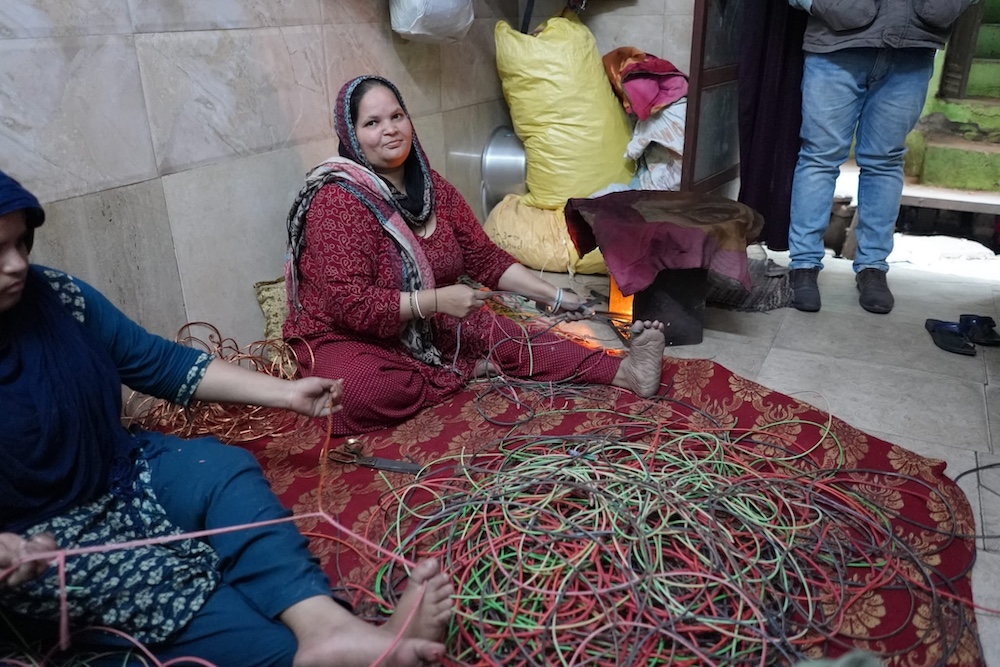
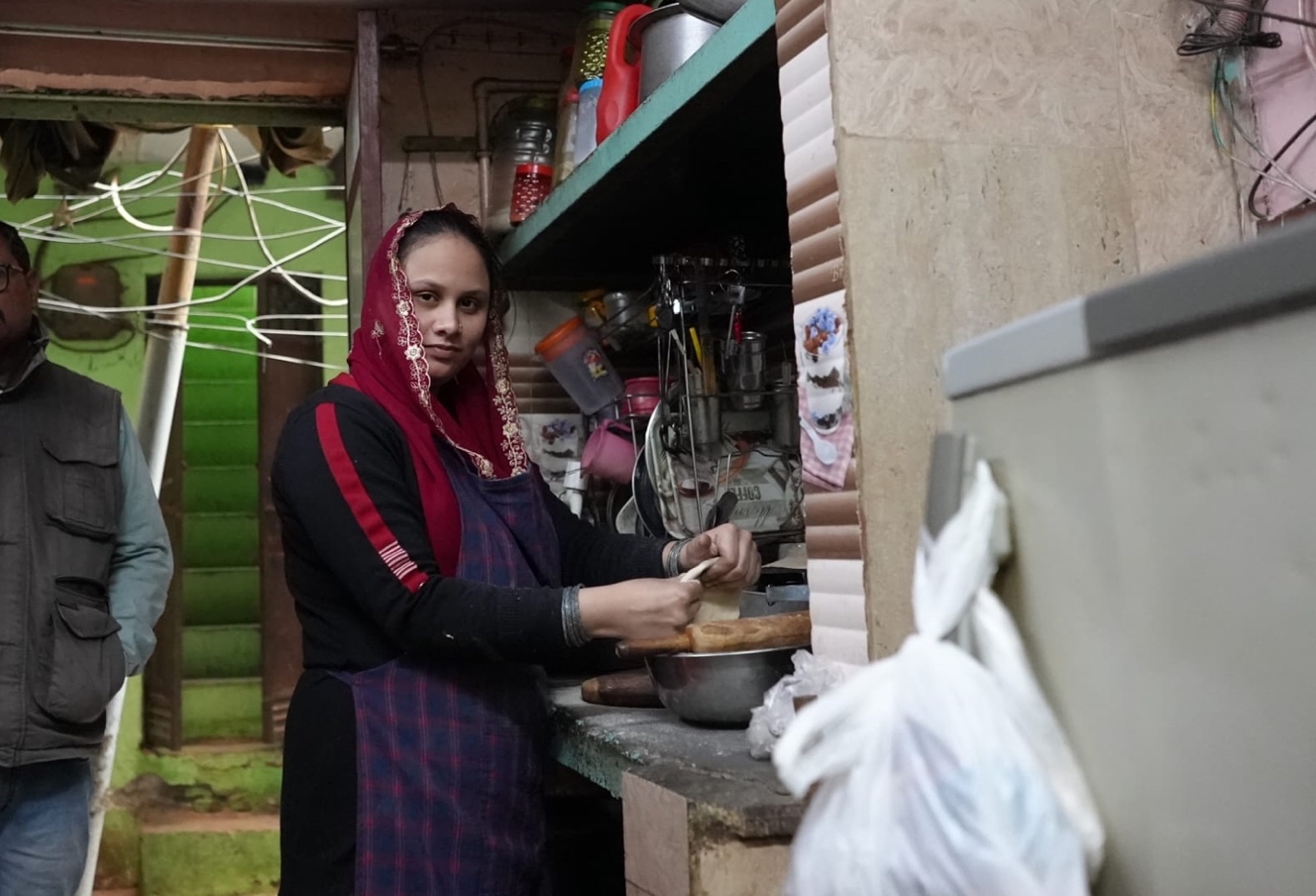
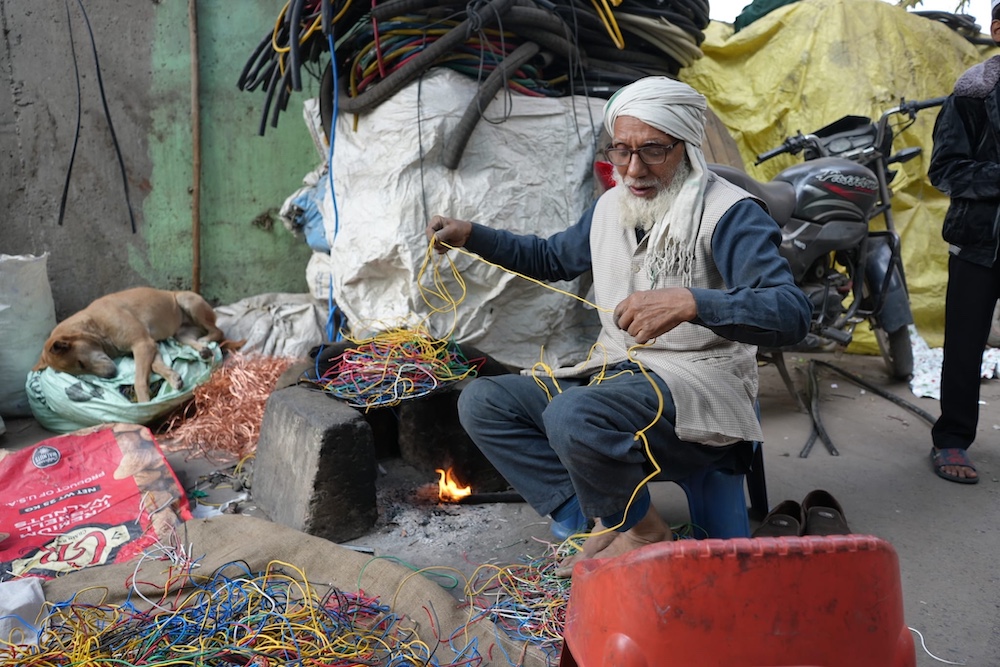
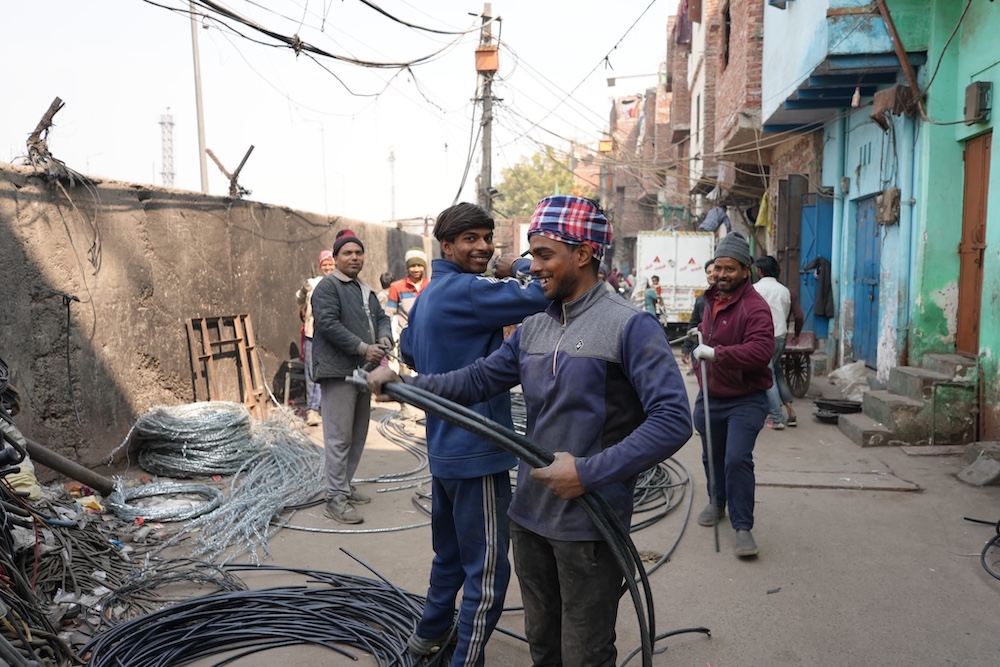
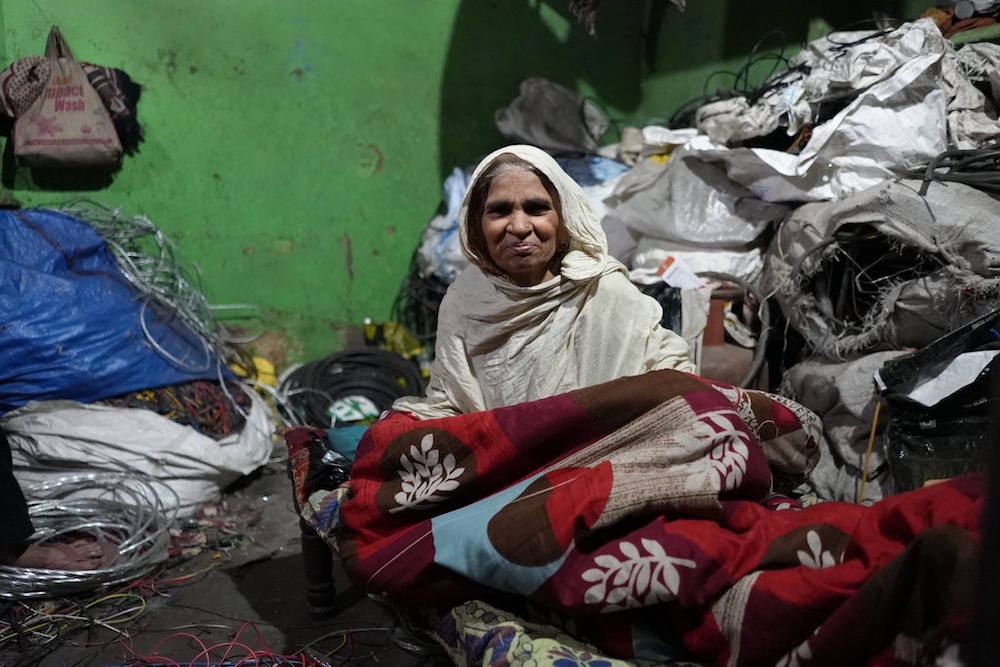
Immersion with Toxics Link in New Delhi: meeting the Kabadiwalas and other upcyclers of e-waste
„Artist and researcher Stefanie Wuschitz followed the Indian NGO Toxics Link in New Delhi, which carries out extensive monitoring work on the links between waste and contamination. For Makery, she examines how the work of women in the slums of New Delhi contributes to the urban mining of electronic waste by manually upcycling valuable materials.“
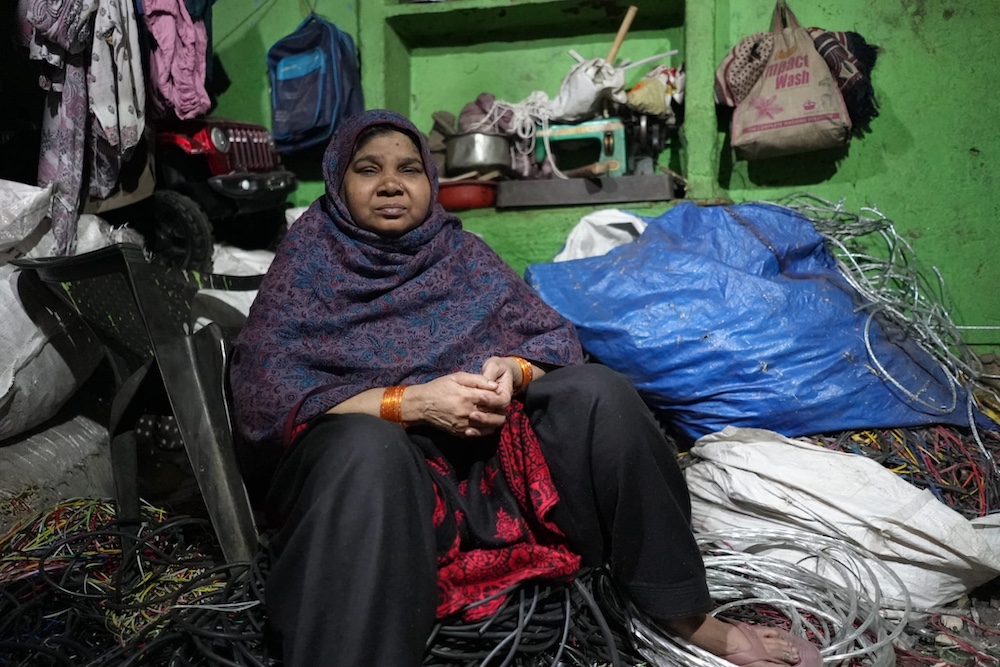
Mother and daughter are busy with wire stripping in one corner of their room.
.
The entire community is involved into the upcycling of wires and cables.Some use simple machines from China to take off the plastic cover, some do it completely manually.This lady has been in New Seelampur since forty years. The air pollution has taken its toll on her lungs.People here would have an easier life if they could rely on formal training, adequate infrastructure and tools to avoid health risks.
We would prefer if you would register for the workshop by emailing a short note to s.wuschitz@akbild.ac.at
A WORKSHOP ON STENCIL BASED STREET ART AS A CRITICAL VISUAL LANGUAGE SITUATED WITHIN PUBLIC SPACE, POLITICAL DISCOURSE, AND PERSONAL NARRATIVE, EXPLORING STENCIL PRACTICE AS A HISTORICALLY AND CONCEPTUALLY SIGNIFICANT METHOD WITHIN CONTEMPORARY STREET ART.
ENGLISH
This workshop proposes an introduction to stencil-based street art as a critical visual language situated within public space, political discourse, and personal narrative. Led by artist Anagard, the sessionexplores stencil practice not merely as a technical process, but as a historically and conceptually significant method withincontemporary street art. Stencil art has long functioned as an accessible and reproducible tool for visual intervention, often employed to disseminate social commentary, political critique, and personal ideologies within urban environments. Through this workshop, participants will engage with the foundational principles of stencil production and application, while reflecting on its role in shaping collective visual culture.
DEUTSCH
Dieser Workshop bietet eine Einführung in die kritische visuelle Sprache von Stencils (deutsch: Schablonen) und Stencil-basierter Street Art. Sie positioniert sich im öffentlichen Raum als Teil politischer Diskurse und als persönliches Narrativ. Der Leiter des Workshops, Anagard, wird mit unterschiedlichen Stencil Praktiken Praktiken experimentieren, was er aber nicht als rein technischen Prozess versteht, sondern als zeitgeschichtlich und konzeptionell relevante Methode innerhalb der gegenwärtigen Street Art Szene. Kunst aus Stencils funktioniert schon seit Längerem als niederschwelliges und reproduzierbares Werkzeug für visuelle Intervention. Stencils dienen der Ausbreitung gesellschaftlicher Kommentare, politischer Kritik und der Äußerung persönlicher Ideologie in urbaner Umgebung. In diesem Workshop setzten sich Teilnehmende mit den grundsätzlichen Prinzipien der Stencil Produktion und Anwendung auseinander. Gleichzeitig reflektieren sie darüber, welche Rolle Stencils in der Entwicklung einer kollektiven visuellen Kultur spielen.
ARTIST STATEMENT ANAGARD / short bio
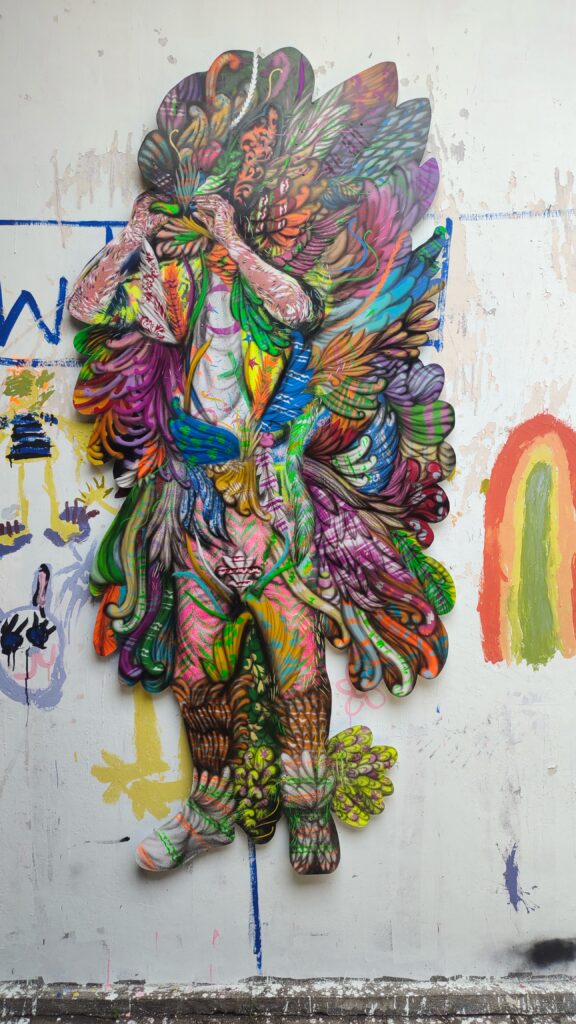
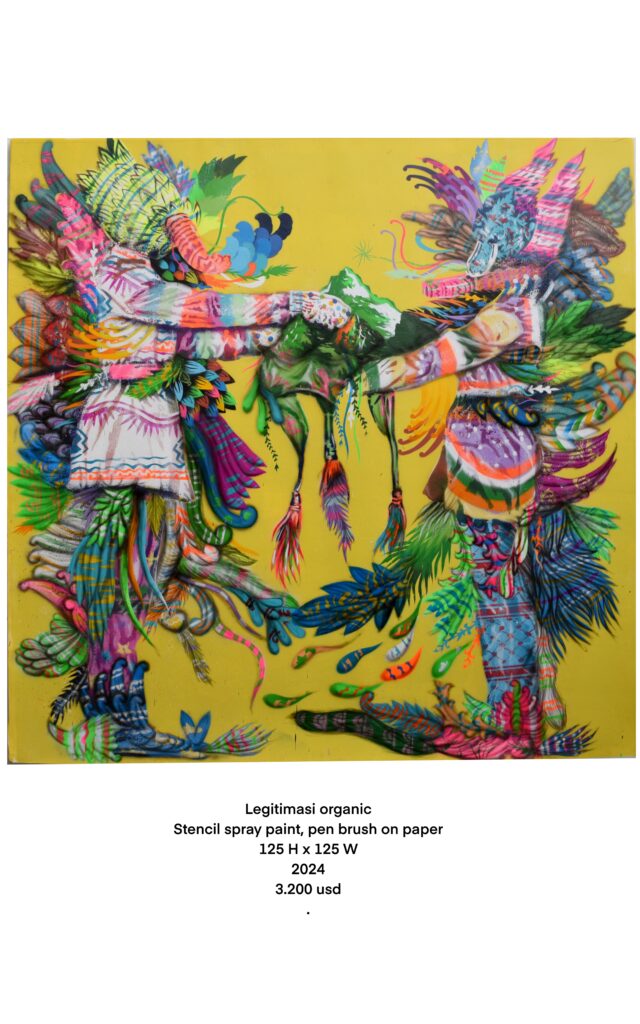
My name is Anagard, I have always been deeply interested in the relationship between art and society, which is why my art is not only in the galleries but also on the street. I learned stencil techniques autodidactically, by directly creating works on city walls. My personal works explore socio-political and environmental issues. I believe that art must contribute to life — it emerges from social turbulence and moves through multiple spaces: from the studio to the street, to the gallery, to the field of research, and finally into private reflection. Through manually cut stencils and spray paint, I consistently bring my work to both public spaces and galleries. The colourful aesthetic and visual character of my work are influenced by my childhood experiences of drawing Minangkabau traditional house ornaments and painting West Sumatran landscapes. Today, my artistic hybridity continues to be shaped by both Sumatran and Javanese culture, particularly in batik patterns, wayang motifs, and the dynamic movements of jatilan dance. My work has also been shown internationally, with solo exhibitions such as From Nasi Padang to the World (NAFA, Singapore, 2024) and Spray, Peace, Diversity (Cuturi Gallery, Singapore, 2022). My public murals and installations have appeared at festivals and biennales across Asia, Europe, and Australia. As Art Director of the Yogyakarta Street Art Festival and founder of Cosmos Street Art community, I am committed to collaboration and exchange and look forward to contributing to the dialogue of community-driven art
Dieser Vortrag von Karina Roosvita wird organisiert vom Elise Richter PEEK Projekt
„Datenkolonialismus in Indonesien. Die Strategien indonesischer Künstler*innen im digitalen Kolonialismus“
und beschäftigt sich mit der ausgelöschten Vergangenheit jener indonesischer Frauen, die bei der Afrika Asien Konferenz 1955 eine tragende Rolle gespielt hatten.
ENGLISH
The Complexities of Clothing in Gendered Practices A reflection on the intersections of art and activism by Karina Roosvita
This presentation examines how clothing works as a structure of power within historical, cultural, and transnational gender politics. Since 2019, Karina have engaged with clothing across different contexts, from everyday use to diplomatic staging and national traditions, to understand how clothing mediates cultural and political identity.
It began with Karina’s research on the Sarong (2019–2020), which revealed that the Sarong, although almost identical to a skirt, is legitimized as masculine clothing through religious authority, patriarchal norms and social consensus. Through The Tea Party Project (2022) her next research examines the erasure of women in Asia Africa Conference 1955 history – while women traditional clothing continued to function as cultural diplomation. Karina expands the research through her residency in Graz (2024), where she learned that traditional clothing in the Austria has become a signifier of conservatism and national trauma, in contrast to the Global South, where kebaya and sarong are tied to class struggle and egalitarian politics.
These trajectories developed into „The Shadow of Being“ (2025), an embroidery and light installation works that highlights women whose identities revealed through „The Tea Party Project“. Drawing from photo archive, Javanese Wayang philosophy, and Naoko Shimazu’s concept of staging diplomacy, the work brings forward those erased history.
DEUTSCH: Über die Komplexität von Bekleidung in Gender Praktiken: Intersektionale Reflektionen zu Kunst und Aktivismus
Diese Präsentation untersucht, wie Kleidung innerhalb historischer, kultureller und transnationaler Gender Politik als Machtstruktur funktioniert. Seit 2019 arbeitet Karina mit Kleidung in unterschiedlichen Kontexten, im Alltag bis zur diplomatischen Inszenierung sowie nationalistisch geprägten Traditionen, und versucht zu verstehen, wie kulturelle und politische Identifikationen über Kleidung mediiert werden. Karinas erstes Research Projekt über den Sarong (2019-2020) zeigte, dass der Sarong, der einem Rock ähnelt, sich als maskulin konnotiertes Kleidungsstück sowie über religiöse Autorität als auch über patriarchale Normen und soziale Konventionen legitimiert. Das darauf folgende Forschungsprojekt widmete sich, anhand des „The Tea Party Project“ (2022), der Auslöschung von Frauen, die ein tragenden Rolle während der Asia Africa Conference 1955 spielten. Karina setzte ihre Untersuchungen während ihrer Artist Residency in Graz (2024) fort, wo sie feststellte, dass traditionelle Kleidung in Österreich mit Konservatismus und nationalistischem Trauma assoziert wird, ganz im Gegensatz zum Globalen Süden, wo Kebaya und Sarong mit Klassenkampf und dem Ziel einer egalitären Gesellschaft in Verbindung gebracht werden. Diese Erfahrung entwickelte sich zum Konzept für The Shadow of Being (2025), eine Stick- und Licht Installation, in der Frauen im Mittelpunkt stehen, die im The Tea Party Project entdeckt worden waren. Die ausradierte Geschichte wird anhand eines Foto Archivs, Javanischer Wayang Philosophie und Naoko Shimazus Konzept der inszenierten Diplomatie rekonstruiert.
A small wooden light sculpture stands on the floor. It consists of a box-like wooden frame with four vertical rods and a flat top. Inside it stands a cut-out embroidered figure of a woman, glowing warmly from a light at the base. The light casts a much larger, softer shadow of the figure onto the wall behind it. The dim surroundings make the glowing embroidery and its shadow the main focus of the image.
Ort: Stallecker Geschäftsfläche, gegenüber vom Rathaus Raabs an der Thaya
GRUPPENAUSSTELLUNG VON WALDFÜNFTEL:
Elisa Bergmann
Janine Jembere
Ulla Rauter
Theresa Schütz
Stefanie Wuschitz
Screenshot
Das Wort für Welt ist Wald
Der Wald als offenes und für Störungen anfälliges System. Der Wald als geistiger und künstlerischer Nährboden, als geschichtlicher Erzähl-Raum und als ein Sehnsuchtsort. Fünf Künstlerinnen und ihre Kinder leben gemeinsam zehn Tage lang in Raabs an der Thaya, suchen das Gespräch mit den Menschen in Raabs und nähern sich dem breiten Thema „Wald“ an. Mit fünf unterschiedlichen Herangehensweisen und künstlerischen Perspektiven nehmen die Künstlerinnen, die in dieser Zeit ein Geschäftslokal im Zentrum von Raabs mit neuem Leben füllen, als „Waldfünftel“ die Herausforderung der offenen Zusammenarbeit an. Im Geschäftslokal der Familie Stallecker, das die Familie den Künstlerinnen für die Ausstellungsdauer freundlicherweise zur Verfügung stellt, werden die entstandenen Werke sowie bestehende Arbeiten der Künstlerinnen zum Thema Wald ausgestellt.
Photo Credits: Yusuf Agus Kurniawan
Graphic Design: Elisa Bergmann
TEILNEHMENDE KÜNSTLERINNEN:
ELISA BERGMANN
In ihrer künstlerischen Praxis widmet sich Elisa Bergmann der Malerei und dem kontinuierlichen Hinterfragen des Mediums sowie seiner Mittel. Überlegungen zu den Produktionsbedingungen von Kunst, insbesondere zur Koexistenz von künstlerischer Praxis und Care-Arbeit, spielen ebenso eine zentrale Rolle sowie Themen der Skalierbarkeit. Diese Aspekte spiegeln sich sowohl in den gewählten Motiven, Techniken und Materialien als auch in ihren räumlich-installativen Übersetzungen wider. Bergmann integriert zudem Elemente einer halbfiktionalen Sprache in ihren Arbeiten, die zum Teil beschreibend, abstrakt und fiktional ist, aber immer auf das private Leben und die Umwelt Bezug nimmt. Ihre Arbeiten wurden unter anderem in le carceri, Caldaro; Avlskarl Gallery, Kopenhagen; Kunstraum Schwaz, Schwaz; KünstlerhausVereinigung, Wien; wasserwasser, Wien; Galerie 5020, Salzburg; Exhibit Studio, Wien; Kunsthalle Bozen; Plan-Raum für Kunst, Hamburg und Galerie Prisma, Bozen ausgestellt.
JANINE JEMBERE
Janine Jembere ist Künstlerin und Lernende in Wien. Sie arbeitet in verschiedenen Konstellationen an Performances, Installationen, Video, Sound und Bildungsprojekten. Ihre Arbeiten beschäftigen sich mit Sinnen und Körpern und befragen Konzepte der Repräsentation und Übersetzbarkeit. Sie interessiert sich für verkörpertes Wissen und das Konzept von Dissonanz als Werkzeug Differenzen zu beschreiben und zu leben. Sie studierte Visuelle Kommunikation/Medien an der Hochschule für bildende Künste Hamburg und war Gaststudentin am Department for Fine Arts and Design der Addis Ababa University, Äthiopien. Ihre Arbeiten wurden unter anderem im Ballhaus Naunynstrasse Berlin, Golden Pudel Club Hamburg, Dokumentarfilmwoche Duisburg, Haus der Kulturen der Welt Berlin, transmediale Berlin, Kunsthalle Bremen, Detroit Public Library, Research Pavillion at the 57th Venice Biennale, Venedig, Museum für Geschichte Sarajevo, Gropius Bau Berlin, mumok Wien gezeigt. Sie war Stipendiatin des Videokünstlerinnenprogramms Berlin 2016, Akademie Schloss Solitude 2016/2017, Fleetstreet Theater Hamburg 2018. Sie war Theoriekuratorin am Tanzquartier – Center for Contemporary Performance & Choreografie, Wien und ist derzeit Post-Doc Researcher im FWF PEEK Projekt Fabricating Adjacency. On Textiles, Trade and Terror. Gemeinsam mit Moira Hille unterrichtet sie das Kolloquium des MA Critical Studies und ist Senior Scientist beim PhD in Practice Programm an der Akademie der bildenden Künste Wien.
ULLA RAUTER
Ulla Rauter, geboren 1980 in Wiener Neustadt, studierte Transmediale Kunst an der Universität für Angewandte Kunst Wien. Sie arbeitet als Medienkünstlerin und Musikerin an der Schnittstelle von Klangkunst und Bildender Kunst – ihre Werke umfassen performative Skulpturen, musikalische Performances und selbstgebaute Instrumente.
Ein Schwerpunkt in ihrer Arbeit ist die Entwicklung experimenteller Klanginterfaces. Ihre sensorbasierten elektronischen Musikinstrumente wurden international in Performances und als Objekte in Ausstellungen gezeigt. Zwei weitere zentrale Themen in ihrer künstlerischen Arbeit sind die Stille als Material und Sehnsuchtsort – zu diesem Thema realisierte sie seit 2009 eine Reihe interaktiver Arbeiten im öffentlichen Raum – und die menschliche Stimme, die sie als Ausgangsmaterial ihrer visuellen und akustischen Übersetzungs- und Transformationsprozesse erforscht.
2010 gründete sie mit Christine Schörkhuber die jährliche Hörschau „Klangmanifeste“. Seit 2013 ist sie Lehrbeauftragte an der Abteilung Digitale Kunst der Universität für Angewandte Kunst Wien.
THERESA SCHÜTZ
lebt und arbeitet in Wien. Sie setzt sich in künstlerisch forschenden und transdisziplinären Projekten mit öffentlichen und sozialen Räumen auseinander. Dabei wird situativ performativ und direkt gestaltend erkundet, was zwischen uns und dem Anderen, Dingen und Orten verhandelt und sinnlich erfahrbar werden kann. Zwischen Kunst und Urbanismus, kultureller Vermittlung und Architektur arbeitet sie seit 2015 selbständig mit Rainer Steurer als unos, oft in Kollaboration mit dérive. Sie mitbegründen das Hidden-Institute in Berlin, initiieren das T/abor in Wien, das Schütz als Raum für Kunst und transdiziplinäre Zusammenarbeit kuratiert. Parallel forschte und lehrte sie an der TU-Wien sowie an Kunsthochschulen in Berlin und Basel, arbeitete in Forschungsprojekten zu Leerstand, Politiken öffentlicher Räume und Handlungsspielräumen von Jugendlichen im öko-sozialen Wandel. Derzeit forscht sie als Doktorandin für Architektur an der TU-Wien im HOPE-Raumlabor zu Bildungslandschaften im Klimawandel und im Doktoratskolleg STE[A+]M zu Kunst als transversale Lernumwelt für das gemeinsame Zukünftebilden mit Kindern und Jugendlichen nach dem digitalen Anthropozän.
STEFANIE WUSCHITZ
Stefanie Wuschitz ist Künstlerin und Forscherin. Von 2009-2023 leitete sie ein feministisches Hacklab in Wien. 2014-2024 hielt sie an internationalen Universitäten Post-Doc Stellen inne (u.a. TU Berlin, UdK, Weizenbaum Institut, Akademie der bildenden Künste Wien, etc.). Ihre Projekte beschäftigen sich mit Strategien zur Entmystifizierung und Entkolonialisierung von Technologie aus öko-feministischer Perspektive. Ihre Videos, Installationen und Zeichnungen wurden in zahlreichen Galerien, Biennalen, Festivals und Einzelausstellungen präsentiert, z.B. Ars Electronica Festival (Österreich), 38c3 (Deutschland), ART|JOG 8 (Indonesien), Bouillants Vern-Sur-Seiche (Frankreich), the Taipei Fringe Festival (Taiwan), the 8th International Sinop Biennial (Türkei) und the 16th International Biennial of Aveiro (Portugal). Sie hatte Einzelaustellungen im Kunstraum pro arte und Galerie 3. Derzeit forscht Wuschitz finanziert vom österreichischen Wissenschaftsfonds (FWF) zu digitalem Kolonialismus.