ART MEETS RADICAL OPENNESS

We organised a panel at AMRO festival, that took place in Linz May 13th until May 17th, 2026

With an intervention and panel, Selena Savic and me tried to start a conversation with Purpel Code rebel and Peretas in Indonesia. Dhyta of Purpel Code and Pitra of Peretas gave us the honor of contributing their experience and insights.

The meeting lived up to the conference title „Becoming Unreadable“ and lead to a breakout room session at AFO in Linz, with international participation.

PANEL PARTICIPANTS:

PERETAS Collective
Peretas, short for perempuan lintas batas (literal translation: women crossing boundaries) works through ands toward the politics of feminist solidarity among women art workers in Indonesia and beyond. The Indonesian word “peretas” means hacker, which renders our spirit to socially hack the stereotypical definition and hegemonic construction that confine women.

(from their website, 2026)

DHYTA / purple rebell of the Purple Code Collective

PurpleCode Collective is a feminist collective focusing on the intersectionality of feminism, human rights, and technology that centres around the people. We put forward our work towards feminist technology that will create a safe, brave, and accountable space for women and other oppressed groups to get together, express, organise, and mobilise. Anchoring our practices in feminist values of intersectionality, we publish original research, build conversations, and gather womxn and queer communities to challenge dominant discourses that shape our technology.

„We are living in the times of rising fascism; techno-fascists’ monopolist platforms take over public services and infrastructures; around the world, we are facing state capitalism + surveillance with patriarchal and neoliberal technologies; we witness the transformation of democratic institutions into corporate feuds. On this panel, we will discuss tactics of continuing, ongoing struggle for equality, recognition and collective survival. Solidarity is more important than ever.
After an initial conversation among the panellists who introduce their perspectives, we will invite the audience to give inputs and take an active part in the debate. The following questions could serve as starting points for a deeper exchange: How does our artistic practice, grounded in local resistance cultures, become (un)readable and/or fruitful for people in other contexts?
How will we connect trans feminist hack networks internationally to become more visible, readable and accountable to each other? How do the Indonesian collectives become unreadable to (and protected from) the extractive practices of Eurocentred companies, corporations and institutions? How can we unlearn extractivist patterns of production in the art world and beyond?“

Text by Selena Savic and Stefanie Wuschitz

SPINNEN STROM

Monday, 11th of May, I will give a workshop at this festival at 4pm, would be fun if you could join.

WHERE: at Schillerplatz 3, Vienna

WHEN: Monday, May 11th at 4pm

With collected old spinning wheels from all over the land we can try to spin electricity. If you want you can bring along spinning wheels, bike dynamos, hub dynamos or old DC motors, if you have got some at home. We will build spinning wheels to generate power and energise various things. Similar to an old bike light where the wheels‘ revolution is translated into light, we as well will use old DC motors to generate energy. The more spinning wheels we can connect to each other, the more we can power with it.

PARTICIPANTS: max. 12

DURATION: 3 hours

PLEASE BRING IF YOU HAVE: old bike lights, spinning wheels, old DC motors, aligator clips

Let’s stick with the Unicorns – Ästhetische Auswirkungen von Pflege, Aufräumen und Wiederverwendung

Datum

11.5.2026–13.5.2026

Schillerplatz

1010 Wien

#workshop

#postdigital

#degrowth

#permacomputing

________________________________

]a[ akademie der bildenden künste wien ________________________________ ]a[ akademie der bildenden künste wien   Mag. Dr. Stefanie Wuschitz MPS
Arts-based research
Elise Richter PEEK Projekt V944
Institute for Education in the Arts (IKL)

https://stefaniewuschitz.cargo.site/s.wuschitz@akbild.ac.at

www.akbild.ac.at

Sent from Proton Mail for Android.

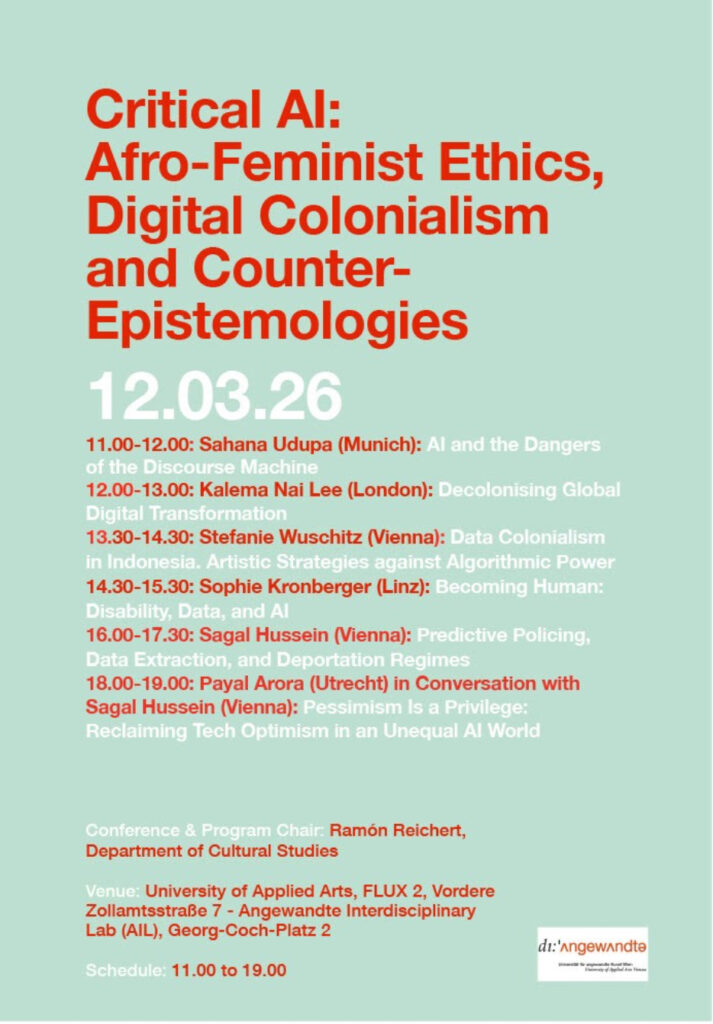
Critical AI: Afro-Feminist Ethics, Digital Colonialism and Counter-Epistemologies

I had the pleasure to talk at this conference organised at the University of Applied Arts Vienna.

Screenshot

Reclaiming Agency in the Age of AI: Afro-Feminist Ethics, Digital Colonialism and Counter-Epistemologies

The conference Critical AI Studies situates Artificial Intelligence within the framework of Cultural Materialism, Critical AI Studies, Black Studies, and Afro-Feminism, approaching AI as a socio-technical formation grounded in data extraction, labour regimes, and global power asymmetries. Central to this perspective is the recognition of data labour as a foundational yet largely invisible component of AI systems, encompassing practices of data generation, annotation, moderation, maintenance, and care. 

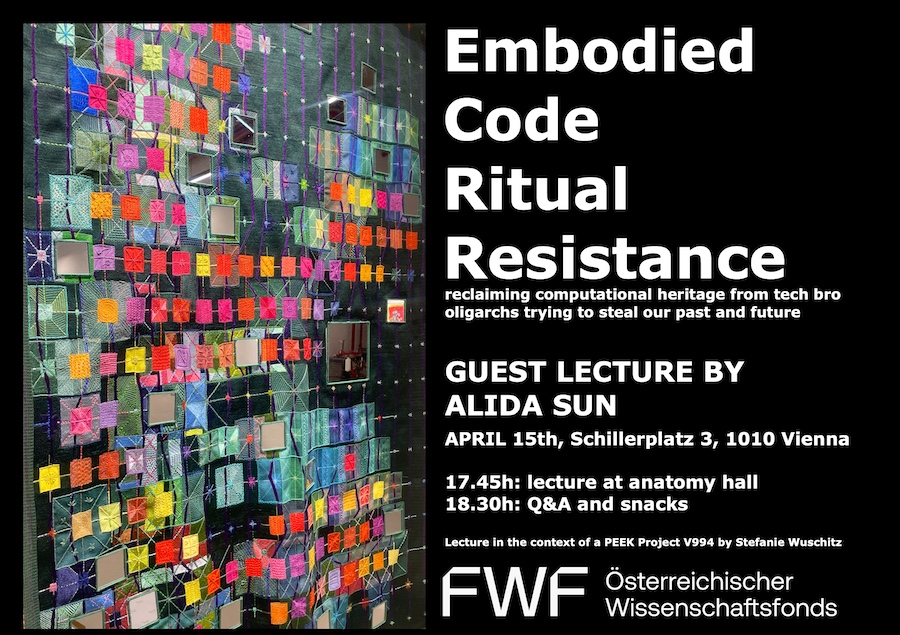
ARTIST LECTURE BY ALIDA SUN


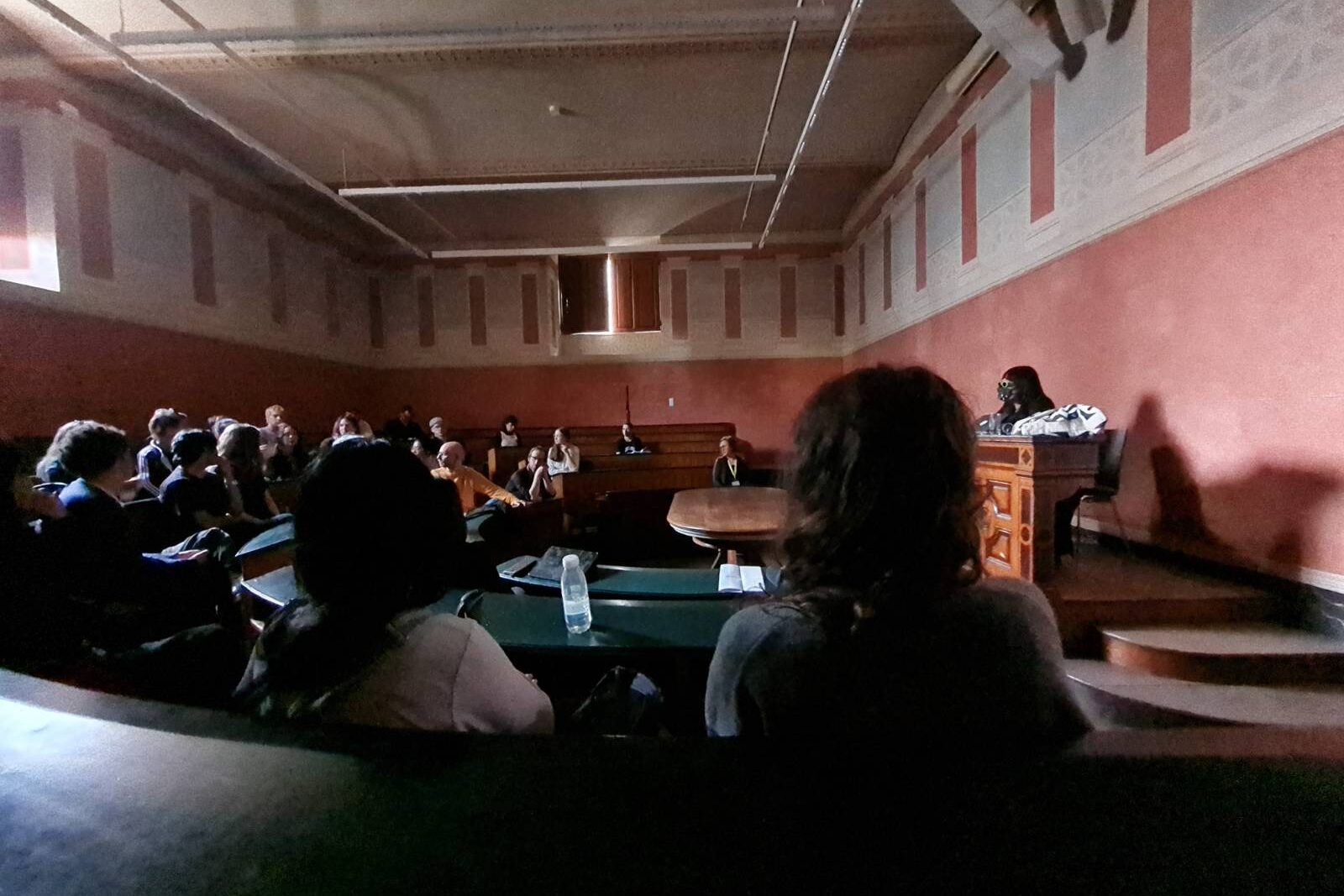
Alida Sun’s work strongly speaks to the topics in my project and
questions we discuss here at the Academy of Fine Arts Vienna. So I felt extremely
honored that she was with us, at the Anatomy hall. We had the chance to have
a Q&A with her afer her lecture.
Alida Sun is based in Berlin at the moment, but has international
art exhibitions, like for example a large solo show in New Delhi.
Alida Sun builds audio-visual instruments that transform her
movements into visuals and sounds. With a background in coding
and tech culture she enjoys coding as a physical process to create
art. This way coding turns into a physical ritual. It reminds us of the
times when art was tangible, hardwired into craft.
When iteration was necessary for crafting and was an embodied
experience. When Alida Sun thinks highly appreciated forms of
self expression in patriarchal society, like tech production, with
highly undervalued forms of self expression, like textile
manufacturing by women weavers in India, she outlines women’s invisible and underpaid
labour.
I want to quote Alida Sun:

“The hierarchy of the two [art versus
craft] is deeply entrenched in patriarchy and colonialism.”

You can follow her Instagram account „alidasun“ to discover a new art
piece there every day since 2500 days.

Embodied Code Ritual Resistance

Alida Sun will explore play as research methodology, data as material for somatic inquiry, and reclaiming computational heritage from tech bro oligarchs trying to steal our past and future.

Photo Credits: Silke Maier. Embodied Code Ritual Resistance

DEUTSCH
In ihrer künstlerischen Forschung experimentiert Alida Sun mit Spiel als Forschungsmethode, Daten als Material für somatische Erkundungen sowie mit der Zurückeroberung unserer Computer-Kultur aus den Händen der Tech Bro Oligarchen, die versuchen, Vergangenheit und Zukunft zu stehlen.

15.APRIL

15.4.2026 von 17.45 – 20.00

ANATOMIESAAL

ARTIST STATEMENT / short bio

Alida Sun is an artist and technologist based in Berlin and New York. Her practice integrates presence, resistance, and adaptation in the age of algorithms. Every day for over 2,000 days and counting she has hand coded a new generative artwork spanning installation, sound, textiles, architecture, choreography, and light.

Her works have been exhibited in museums and galleries including UCCA Center for Contemporary Art, Scottsdale Museum of Contemporary Art, bitforms, Unit London, as well as media art festivals around the world.

Abstract:

How can critical code and free open source software community empower artistic imagination while resisting Big Tech’s complicity in war and imperialism? How do we sustain creative practices in the age of algorithms beyond planned obsolescence and proprietary subscriptions? This lecture offers insights from over 2,500 consecutive days of hand-coded art by Alida Sun, who maintains an international career using intentionally secondhand salvaged tech well over a decade old. We’ll explore play as research methodology, data as material for somatic inquiry, and reclaiming computational heritage from tech bro oligarchs trying to steal our past and future.

DEUTSCH

Wie kann die Critical Code und Open Source Software Community künstlerische Projekte empowern und gleichzeitig Widerstand gegen Big Tech’s Komplizenschaft in Krieg und Imperialismus leisten? Wie können wir im Zeitalter der Algorithmen kreative Praktiken am Leben erhalten, jenseits der eingebauten Sollbruchstellen, ohne uns der Kommerzialisierung vollends zu verschreiben? Dieser Vortrag gibt Einblick in ein Projekt, in dem dem Alida Sun über 2500 auf einander folgende Tage kunst-basierten Code programmiert hat. Alida Sun ist eine international renommierte Künstlerin, die bewusst second Hand, und veralterte Computer weiterverwendet. In ihrer künstlerischen Forschung experimentiert Alida Sun mit Spiel als Forschungsmethode, Daten als Material für somatische Erkundungen sowie mit der Zurückeroberung unserer Computer-Kultur aus den Händen der Tech Bro Oligarchen, die versuchen, unsere Vergangenheit und Zukunft zu stehlen.


Bio:

Alida Sun is an artist and technologist based in Berlin and New York. Her practice integrates presence, resistance, and adaptation in the age of algorithms. Every day for over 2,000 days and counting she has hand coded a new generative artwork spanning installation, sound, textiles, architecture, choreography, and light. Her works have been exhibited in museums and galleries including UCCA Center for Contemporary Art, Scottsdale Museum of Contemporary Art, bitforms, Unit London, as well as media art festivals around the world.

MEETING AND WORKSHOP AT WAAG FOUNDATION AND INFRASTRUCTURE LAB

It was specifically a great honor to have a deeper exchange with Fieke Jansen and Niels van Oever (Critical Infrastructure Lab) and Judith Veenkamp (Waag Foundation) who invited me to Amsterdam.

Together with Patricia J. Reis I was invited to give a lecture in Amsterdam at the historical building in which VOC was founded. A sad memorial of centuries of colonialism. But the audience was wonderful, asking many fantastic questions and sharing about their own art and research critical of extractivism and aiming for decolonial tech in the arts. In the audience there were wonderful people like the author of „The Art of Hacking“, Julie Laczko and the artist Zach Furst who created the compost.cc project, the artistic researcher Selena Savic and many others, who also later joined our workshop. The workshop was held at critical infrastructure lab at Amsterdam University.

The second part of the workshop was held at WAAG FOUNDATION. At their future lab in the heart of Amsterdam. It was an amazing experience to meet so many excellent artists, activists, digital rights activists, scholars and theorists.

After these events I had a project meeting with Dorine van Meel (Earthbound Hardware Workshop) Anja Groten (Hackers and Designers, University of Amsterdam) and Heerko van der Kooij (Hackers and Designers). After this real and physical meeting we had an online working session with students and Indonesian artist Ismal Muntaha.

Delivered first book draft to proof editor

Just before Easter I sent the manuscript of my book to my proof editor in the UK. It was a big step for me to let go of it and accept that I cannot write more than 100.000 words. I, however, will make another book from the parts I had to delete, as I believe that some of the interviews need to be published in original lenght.

Women in Urban Mining of Hardware

With the magazine MAKERY that is focusing on media art and labs I published an article on e-waste upcycling in India.

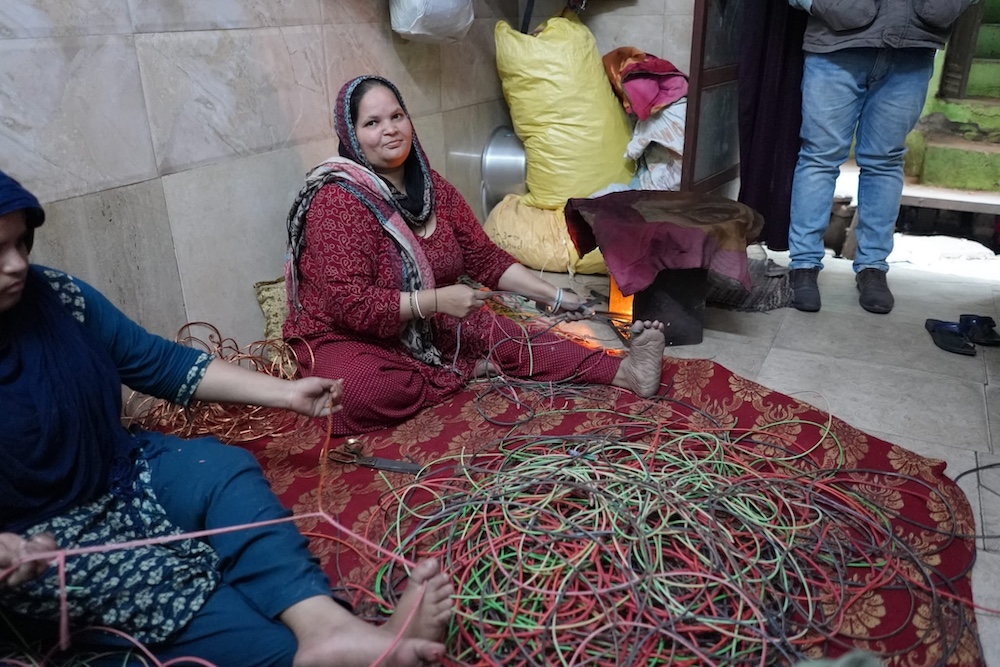
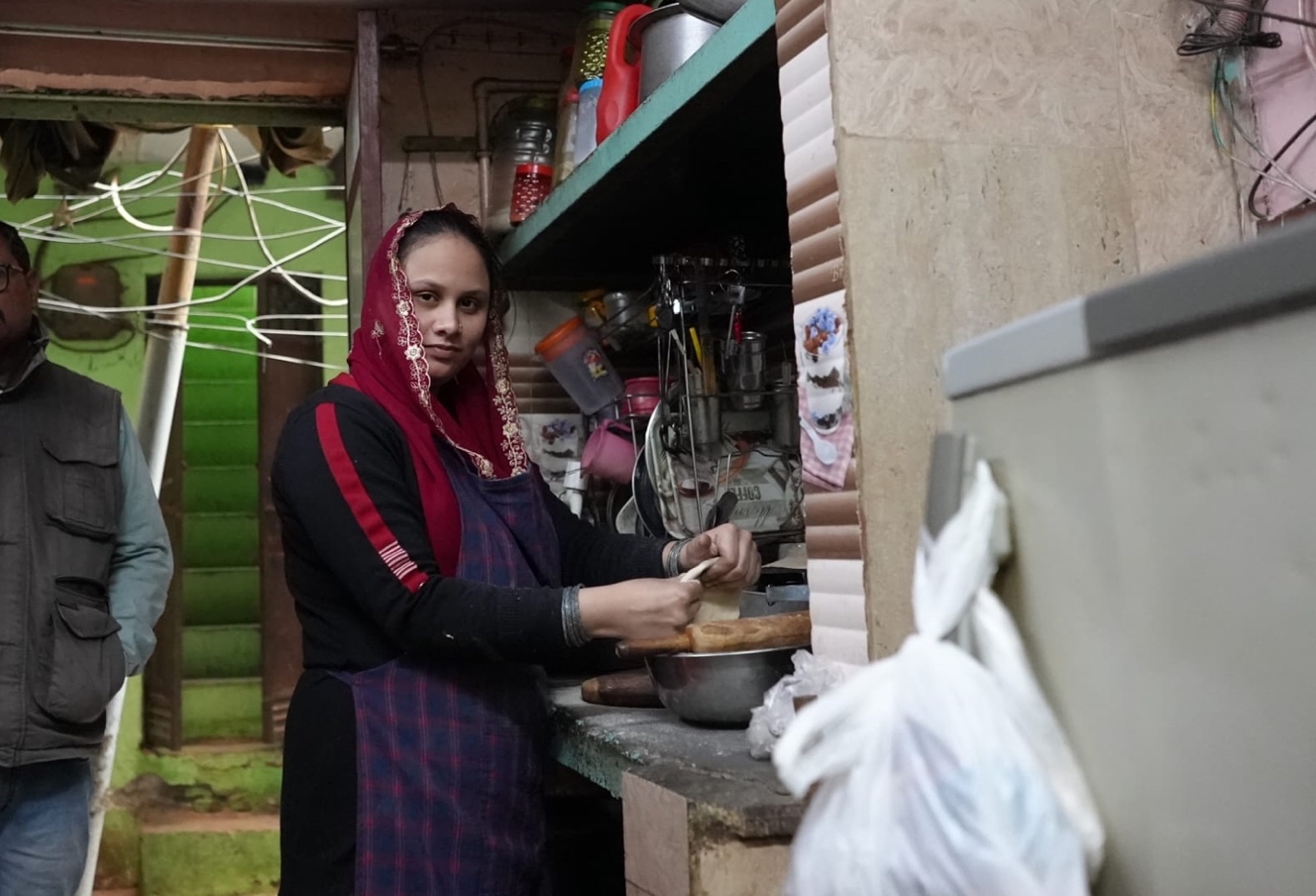
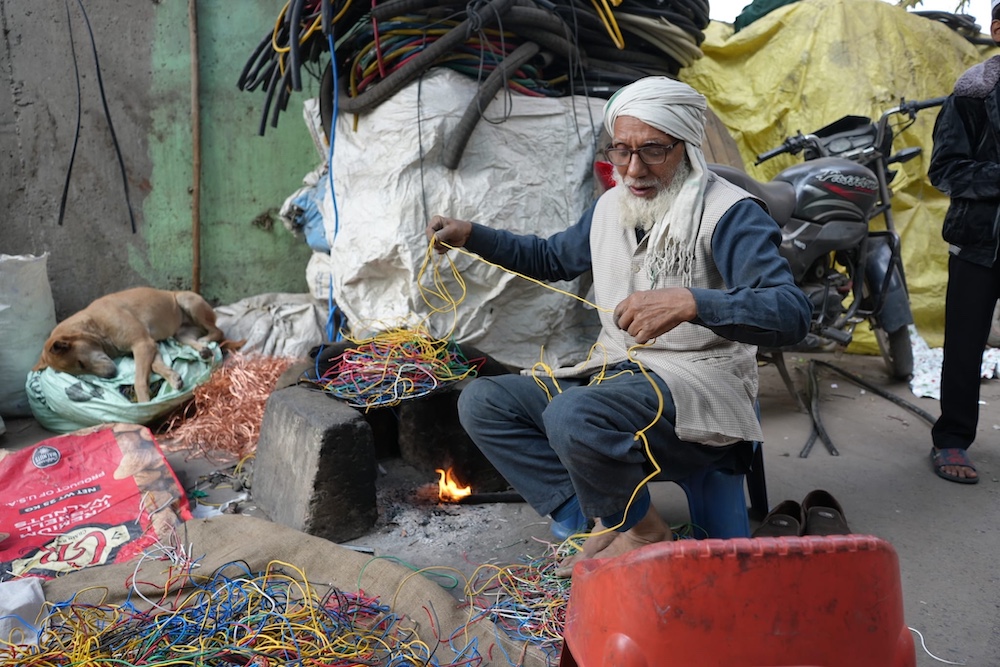
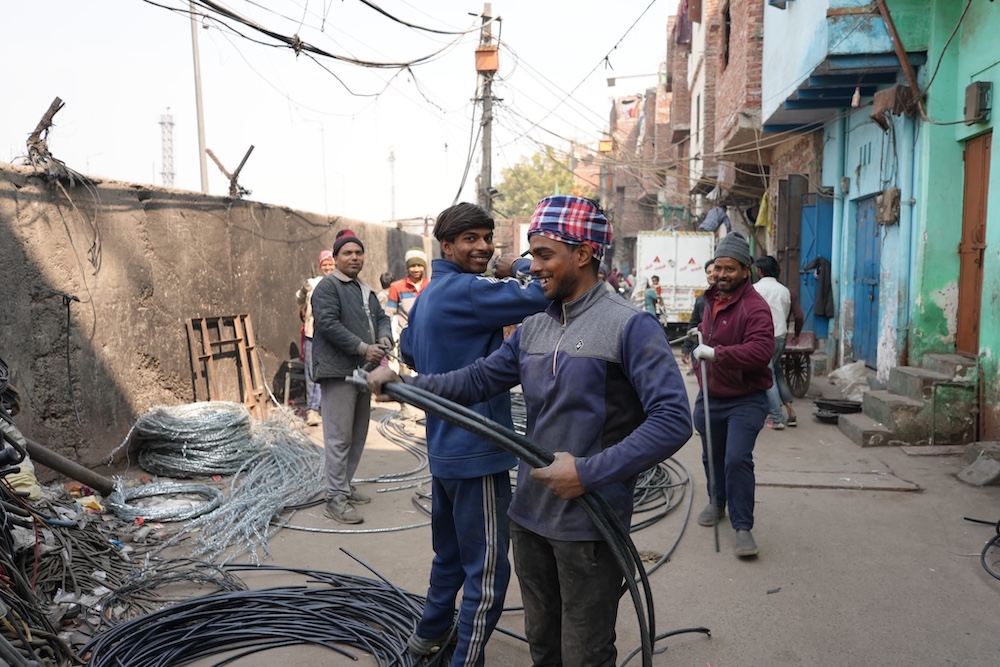
Immersion with Toxics Link in New Delhi: meeting the Kabadiwalas and other upcyclers of e-waste

„Artist and researcher Stefanie Wuschitz followed the Indian NGO Toxics Link in New Delhi, which carries out extensive monitoring work on the links between waste and contamination. For Makery, she examines how the work of women in the slums of New Delhi contributes to the urban mining of electronic waste by manually upcycling valuable materials.“

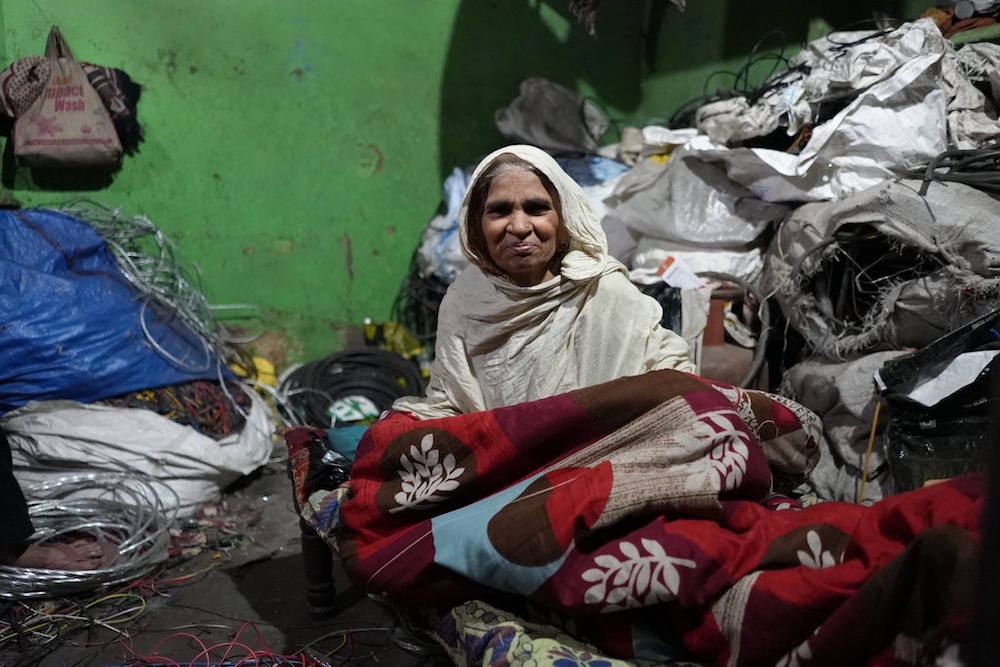
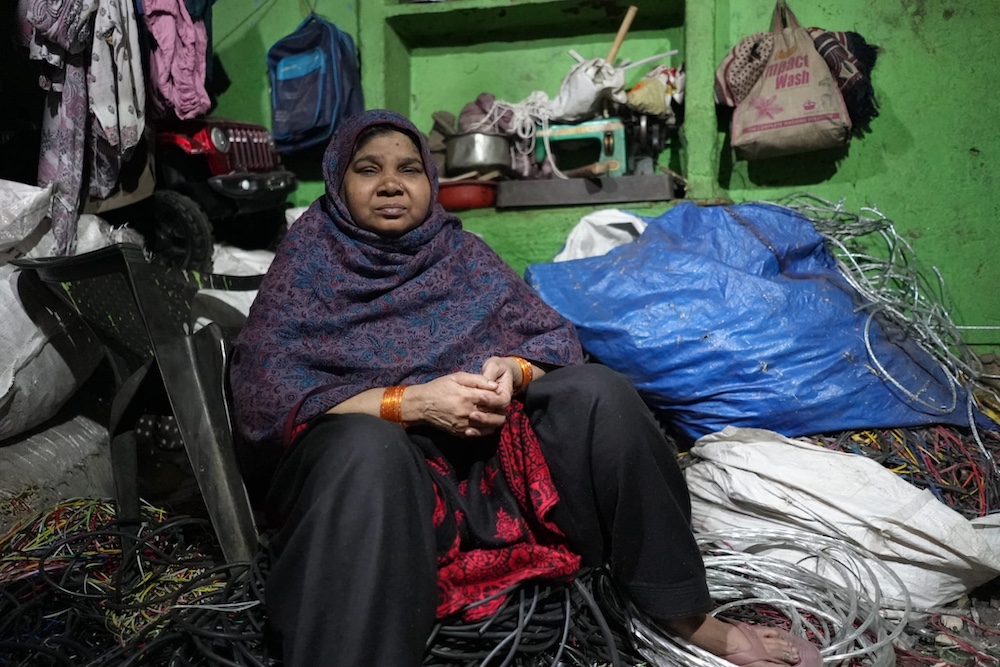
Mother and daughter are busy with wire stripping in one corner of their room.

.

The entire community is involved into the upcycling of wires and cables.
Some use simple machines from China to take off the plastic cover, some do it completely manually.

This lady has been in New Seelampur since forty years. The air pollution has taken its toll on her lungs.
People here would have an easier life if they could rely on formal training, adequate infrastructure and tools to avoid health risks.

PERMA FARMING AND PERMA COMPUTING

Artist in Residence at FARM 8

I spent an extremely nurturing and inspiring time at Rashmi Kaleka’s 

Perma Culture Farm in New Delhi.

During this residency I generated a lot of work that inspired my writing.


Perma Culture Farm in New Delhi.

During this residency I generated the work I describe in this article

Photo Credits: Stefanie Wuschitz.
On the photo: Rashmi Kaleka, Maya Minder (soil assembly), Stefanie Wuschitz

Photo Credits: Stefanie Wuschitz.
On the photo: Rashmi Kaleka, Maya Minder (soil assembly), Stefanie Wuschitz

Street Art Workshop:

Stencil as a Critical Visual Language

LINK

WHEN:

22.1.2026, 1 pm – 5 pm

WHERE:

Karl Schweighofergasse, Vienna – Room 3.01 

@anagard_stcl

@anagard_artchive

We would prefer if you would register for the workshop by emailing a short note to s.wuschitz@akbild.ac.at

A WORKSHOP ON STENCIL BASED STREET ART AS A CRITICAL VISUAL LANGUAGE SITUATED WITHIN PUBLIC SPACE, POLITICAL DISCOURSE, AND PERSONAL NARRATIVE, EXPLORING STENCIL PRACTICE AS A HISTORICALLY AND CONCEPTUALLY SIGNIFICANT METHOD WITHIN CONTEMPORARY STREET ART.

ENGLISH

This workshop proposes an introduction to stencil-based street art as a critical visual language situated within public space, political discourse, and personal narrative. Led by artist Anagard, the sessionexplores stencil practice not merely as a technical process, but as a historically and conceptually significant method withincontemporary street art. Stencil art has long functioned as an accessible and reproducible tool for visual intervention, often employed to disseminate social commentary, political critique, and personal ideologies within urban environments. Through this workshop, participants will engage with the foundational principles of stencil production and application, while reflecting on its role in shaping collective visual culture.

DEUTSCH

Dieser Workshop bietet eine Einführung in die kritische visuelle Sprache von Stencils (deutsch: Schablonen) und Stencil-basierter Street Art. Sie positioniert sich im öffentlichen Raum als Teil politischer Diskurse und als persönliches Narrativ. Der Leiter des Workshops, Anagard, wird mit unterschiedlichen Stencil Praktiken Praktiken experimentieren, was er aber nicht als rein technischen Prozess versteht, sondern als zeitgeschichtlich und konzeptionell relevante Methode innerhalb der gegenwärtigen Street Art Szene. Kunst aus Stencils funktioniert schon seit Längerem als niederschwelliges und reproduzierbares Werkzeug für visuelle Intervention. Stencils dienen der Ausbreitung gesellschaftlicher Kommentare, politischer Kritik und der Äußerung persönlicher Ideologie in urbaner Umgebung. In diesem Workshop setzten sich Teilnehmende mit den grundsätzlichen Prinzipien der Stencil Produktion und Anwendung auseinander. Gleichzeitig reflektieren sie darüber, welche Rolle Stencils in der Entwicklung einer kollektiven visuellen Kultur spielen.

ARTIST STATEMENT ANAGARD / short bio

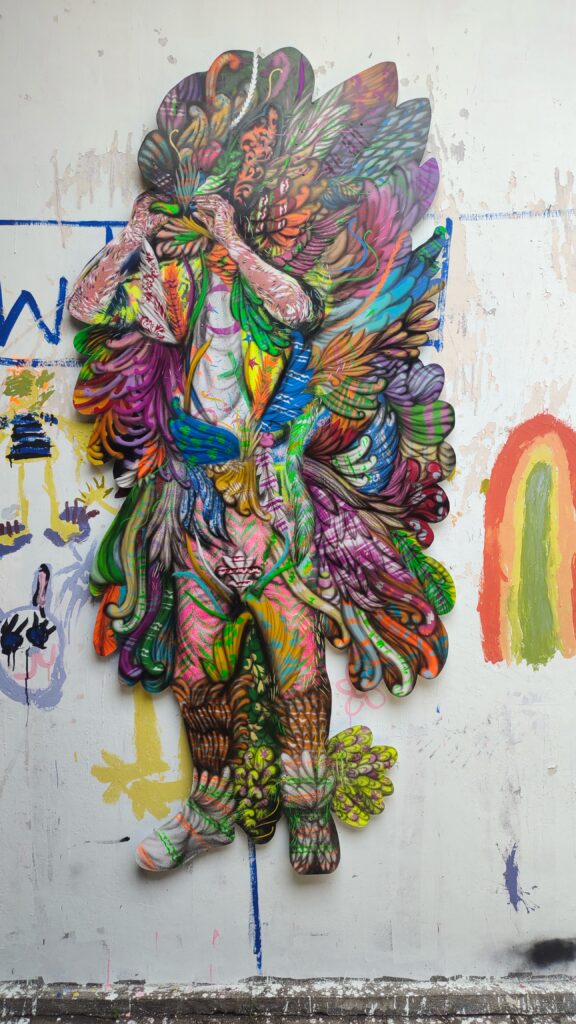
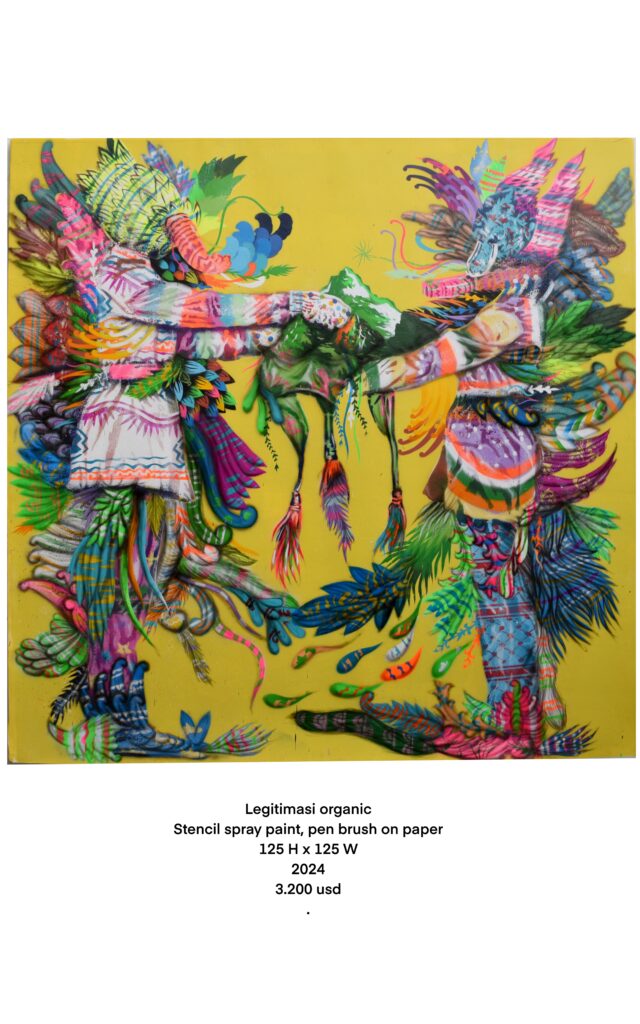
My name is Anagard, I have always been deeply interested in the relationship between art and society, which is why my art is not only in the galleries but also on the street. I learned stencil techniques autodidactically, by directly creating works on city walls. My personal works explore socio-political and environmental issues. I believe that art must contribute to life — it emerges from social turbulence and moves through multiple spaces: from the studio to the street, to the gallery, to the field of research, and finally into private reflection. Through manually cut stencils and spray paint, I consistently bring my work to both public spaces and galleries. The colourful aesthetic and visual character of my work are influenced by my childhood experiences of drawing Minangkabau traditional house ornaments and painting West Sumatran landscapes. Today, my artistic hybridity continues to be shaped by both Sumatran and Javanese culture, particularly in batik patterns, wayang motifs, and the dynamic movements of jatilan dance. My work has also been shown internationally, with solo exhibitions such as From Nasi Padang to the World (NAFA, Singapore, 2024) and Spray, Peace, Diversity (Cuturi Gallery, Singapore, 2022). My public murals and installations have appeared at festivals and biennales across Asia, Europe, and Australia. As Art Director of the Yogyakarta Street Art Festival and founder of Cosmos Street Art community, I am committed to collaboration and exchange and look forward to contributing to the dialogue of community-driven art